Valle Scuropasso
REGION: Lombardia
DENOMINATION: Oltrepò Pavese Metodo Classico
MGA: Valle Scuropasso
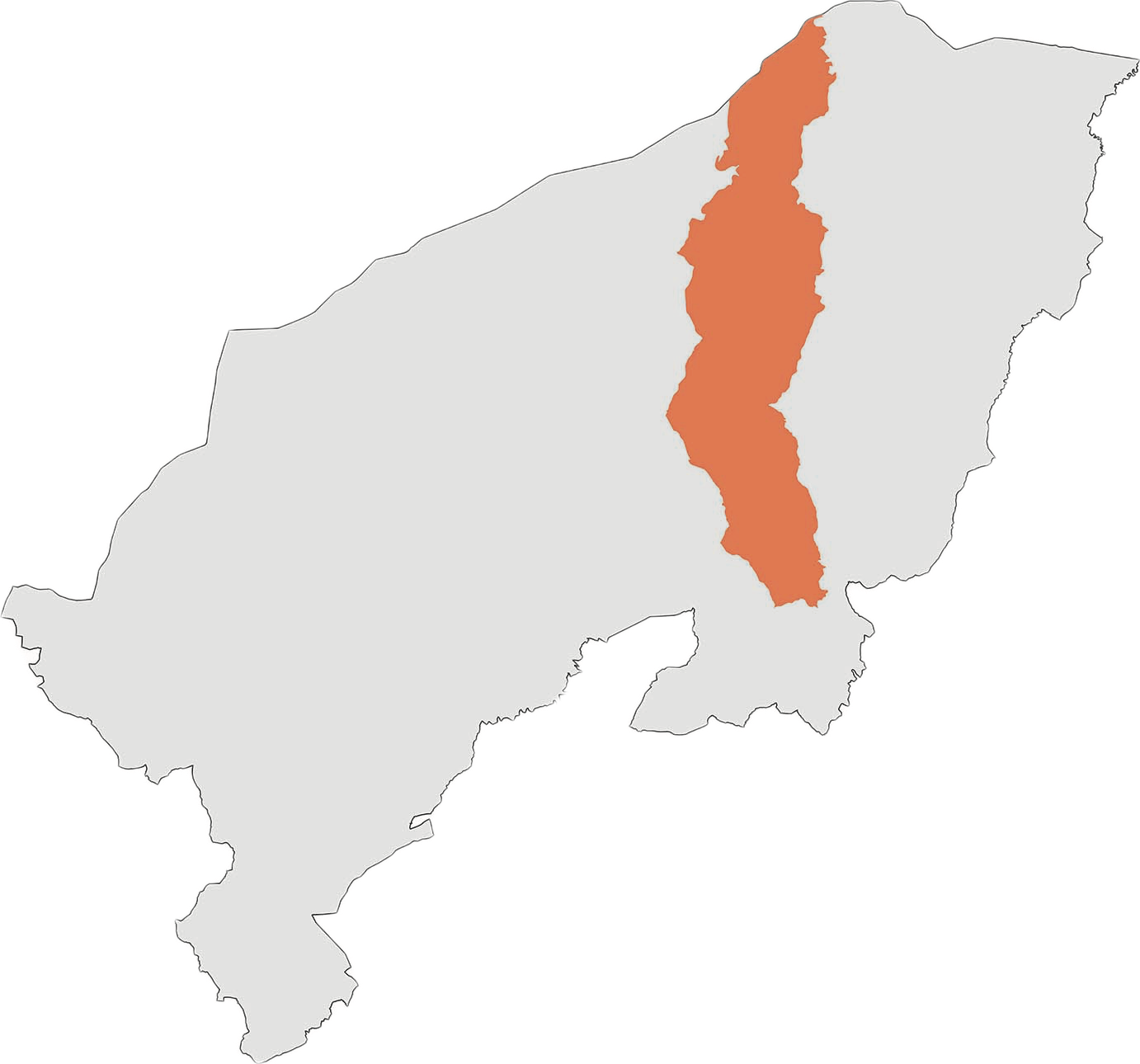
TOTAL AREA: 4862 hectares (2066 under vine)
While Valle Versa represents the productive heart of the Oltrepò Pavese, when it comes to history – and more specifically the history of Metodo Classico sparkling wine made from pinot noir – Valle Scuropasso is invariably the first name that comes to mind.
It was in this very Valley that the first pinot noir vine cuttings arrived in 1850, thanks to the collaboration between Carlo Gancia and Count Augusto Giorgi di Vistarino. Just a few years later, in 1865, the same collaboration gave rise to the first pinot noir-based metodo classico sparkling wine produced on the Giorgi di Vistarino family estate, which still stands today in the heart of Valle Scuropasso. Villa Fornace serves as its landmark.
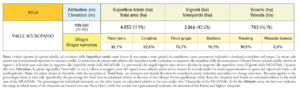
Over time, this historical first has helped to cement the link between Valle Scuropasso and pinot noir, to the extent that today the vineyards dedicated to this grape variety account for over 30% of the total area under vine in the MGA. Referring to the table below, we can also see that Valle Scuropasso is characterised by a vineyard density slightly lower than that of Valle Versa (42.6%), demonstrating how viticulture is, in general, a very important feature of the economy in this MGA.
Another point worth comparing with Valle Versa is the different distribution of altitudes of the vineyards. Although Valle Scuropasso has a similar overall elevation range, its narrower valley configuration means that the bulk of the vineyards are concentrated between 100 and 360 meters above sea level.
On a related note, the second figure here below, while it only refers to cadastral parcels where pinot noir accounts for more than 75%, reveals that the vineyards planted to this variety are concentrated mainly in the central-southern part of Valle Scuropasso. However, if we look at the vineyards as a whole and without distinguishing by grape variety, the data shows that viticulture is concentrated in the central-northern part of the MGA. This finding confirms what we’ve already seen in Valle Versa and which we’ll encounter later in Valle Coppa and Valle Staffora.
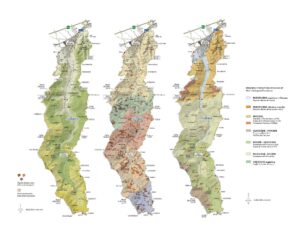
Addressing the other grape varieties cultivated, it’s worth noting the significant decline in croatina compared to what we saw in Valle Versa. However, this doesn’t prevent it being by far the most widely cultivated variety in the “prima collina” area (see the footnote) between Canneto Pavese, Broni, and Cigognola.
Still on the topic of the “prima collina” – shown in yellow in the second map – the geological transition between the Sant’Agata Fossili marls and the Val Luretta Formation, which marks its southern boundary, also signals the start of the area of Valle Scuropasso most closely associated with pinot noir and metodo classico production. Specifically, Scorzoletta is encountered first (shown in green in the figure on page 27), with the vineyards of Bosco Casella on one side and those of Scagno and Fitti on the other, where the landscape resembles in many respects that of the central part of Valle Versa.
That said, it takes just a few hundred metres for that same landscape to begin to significantly change, marking the transition to the central part of the MGA. A greater presence of woodland in its southern part and a valley that gradually narrows are the distinctive features of the famous Lirio area, once a commune in its own right and now part of Montalto Pavese, to which we can add the vineyards of Finigeto and those on the western slope of Francia.
Continuing south, the unmistakeable ridge of Calcaprina and the Stallera farmstead mark the boundary with another historic area for pinot noir, namely Villa Fornace and the many estates belonging to it, such as the Pernice farmstead. Dominated to the west by the also unmistakeable Costa del Vento ridge – which is entirely devoid of vineyards, as are most of the areas characterised by clayey breccias – this area falls almost entirely within the Rocca de’ Giorgi commune, with the exception of Bosco della Chiesa, which lies in the commune of Montalto Pavese. As well as the greater presence of woodland, features of this area are the Monte Piano marls on the left-hand side of the valley and the Antognola Formation on the side towards Bellaria, San Michele, and Cerchiara, whilst in the central part the Val Luretta Formation, in one of its many forms, predominates.
Once past the Rocca de’ Giorgi Castle and on reaching the distinctive wooded hill of Cascina San Silvestro, the valley opens out again into a sort of amphitheatre shape that stretches to the foot of Pometo, where we find the few vineyards of Valle Scuropasso that rise to over 450 meters above sea level.
- The term “prima collina” refers to the hilly area between Casteggio and Stradella that overlooks SR 10 and, by extension, the Po Valley.
Per approfondire:
Oltrepo Pavese Classese
Oltrepo Pavese Classese: la Mappa