


Barolo – The Appellation in a Nustshell
The Appellation in a nutshell
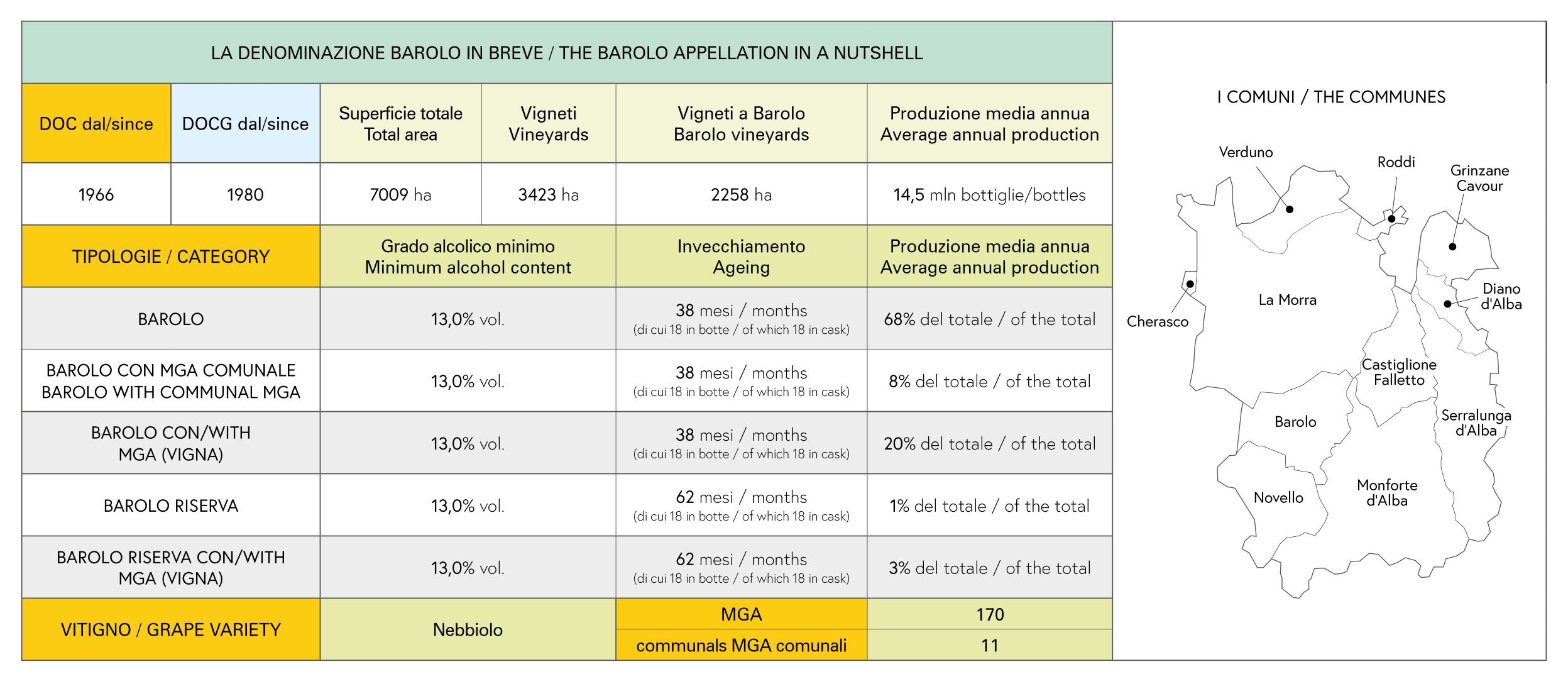
The Barolo appellation protects wines produced exclusively from the Nebbiolo grape variety in an area of approximately 7,000 hectares in the Langhe, a region located in the southern part of the Piedmont Region (northwestern Italy).
Already defined by a ministerial decree dated August 31, 1933, this area includes 11 municipalities in the province of Cuneo: Barolo, Castiglione Falletto, and Serralunga d’Alba are included in their entirety, while the municipalities of Cherasco, Diano d’Alba, Grinzane Cavour, La Morra, Novello, Monforte d’Alba, Roddi, and Verduno are only partially included.
HISTORY OF REGULATIONS
The “Barolo” designation was officially established as a Denominazione di Origine Controllata (DOC) by Presidential Decree on April 23, 1966, and recognized as a Denominazione di Origine Controllata e Garantita (DOCG) by Presidential Decree on July 1, 1980. However, it is possible to find bottles on the market labeled as DOC or DOCG from vintages predating their approval, since the regulation applied retroactively to wines that were still in the cellars at the time.
The production regulations have been amended several times* until the most recent updates, published in the Official Gazette No. 301 of December 30, 2025, and submitted to the European Commission for approval by a Provision dated March 4, 2026.
* Ministerial Decrees: September 30, 2010; November 26, 2010; November 30, 2011; March 7, 2014; April 17, 2015; July 30, 2020.
Download the updated production regulations:
DOCG Barolo – Consolidated production regulations attached to the Order of March 4, 2026
TYPES
The regulations provide for two categories reserved for red wines that must be produced exclusively from 100% Nebbiolo grapes.
Barolo. It must age for at least 18 months in wooden barrels and may be sold starting on January 1 of the fourth year following the harvest (a minimum of 38 months in the cellar, calculated from November 1 of the year the grapes were harvested).
Barolo Riserva. It must age for at least 18 months in wooden barrels and may be sold starting on January 1 of the sixth year following the harvest (a minimum of 62 months in the cellar, calculated from November 1 of the year the grapes were harvested).
For both types, a maximum yield of 80 quintals (grapes) and 56 hectoliters (wine) per hectare is established, while the minimum natural alcohol content by volume* cannot be less than 12.5% vol.
A specific case is represented by Barolo and Barolo Riserva wines that bear the “Vigna” designation (see), for which more restrictive production and analytical parameters apply.
* The potential alcohol content that the must possesses prior to any enrichment treatment or additional fermentation.
MENZIONI GEOGRAFICHE AGGIUNTIVE (MGAS)
MGAs (Additional Geographical Mentions) identify more specific, officially demarcated production areas within a designation of origin. They may correspond to municipalities, hamlets, place names, or other administratively recognized areas, whose names must appear in a specific list attached to the production regulations.
In accordance with the amendments approved in 2010, 181 Menzioni Geografiche Aggiuntive (11 “municipal” and 170 “sub-municipal”) are officially recognized for the Barolo designation. MGAs may be claimed on the label provided that the origin of at least 85% of the grapes in the blend is traceable to that area; however, there are no additional requirements beyond the general ones established for the Barolo and Barolo Riserva categories.
MENZIONI VIGNA (VINEYARD DESIGNATIONS)
Barolo and Barolo Riserva wines that claim an MGA may include the term “Vigna,” followed by the specific name of the vineyard, thereby referring to a more specific vineyard parcel located within the MGA. Unlike in other appellations, in the Barolo DOCG it is not permitted to use the “Vigna” designation on the label without specifying the MGA in which it is located.
For Barolo and Barolo Riserva wines that claim the “Vigna” designation, more restrictive parameters apply: the maximum yield may not exceed 72 quintals (grapes) and 50.4 hectoliters (wine) per hectare, while the minimum natural alcohol content by volume may not be less than 13% vol.
OTHER SPECIFICATIONS SET FORTH IN THE REGULATIONS
Soil Conditions. Barolo cannot be produced from vineyards planted in valley-floor soils that are damp, flat, or do not receive sufficient sunlight.
Altitudes. Barolo cannot be produced from vineyards located at elevations below 170 meters above sea level or above 540 meters above sea level.
Planting Density. New vineyards, including those undergoing replanting, must have a density of no less than 3,500 vines per hectare.
Winemaking Regulations. Winemaking, mandatory aging, and bottling must take place within the Barolo production area, except for specific exceptions or exemptions granted by the competent Ministry to wineries that have historically operated outside the DOCG zone.
Barolo Chinato. This designation is permitted for wines aromatized using Barolo wine as a base, without the addition of musts or wines that are not eligible for the appellation. This aromatization must also possess characteristics that allow for a reference to cinchona in the designation.
DATA AND SURFACES
The vine area eligible for Barolo DOCG production is just under 2,300 ha* (out of a total vineyard area of approximately 3,600 hectares).
La Morra is the municipality with the largest vineyard area eligible for Barolo DOCG (approximately 580 hectares), while Cherasco has the smallest (approximately 3 hectares).
In the 2022 harvest, just over 100,000 hectoliters were declared as Barolo DOCG, corresponding to a potential of approximately 14,500,000 0.75-liter bottles—a figure that is virtually identical to the average for the past decade.
* Data updated as of 2025.